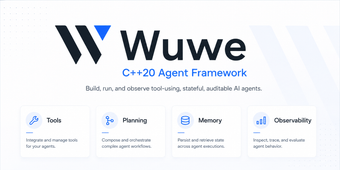
Wuwe: C++ Framework for Building Auditable AI Agents
Wuwe, developed by Lkimuk, is a C++20 framework for building intelligent, tool-using AI agents in native applications and command-line environments. The framework provides a modular runtime that enables stateful agents to reason, plan, and invoke external tools through a standardized protocol. It includes model-access hooks, memory persistence, and tool schema support for production-minded deployments. The target audience is C++ developers and AI engineers who need native agent integration with controllable execution.
What tasks can you actually use it for?
Wuwe configures agents to handle AI-driven text localization and multi-step tool orchestration by exposing model-access and tool-calling modules. The framework supplies typed tool schemas and automated dispatching, which map structured inputs to host functions. Retrieval-augmented generation is available via embeddings and reranking, so agents can combine retrieved documents with model outputs for translation, adaptation, and context-aware rewriting tasks. Developers can chain tools into pipelines for staged localization tasks.
How auditable and controllable are agent actions?
The framework enforces observable, policy-bound execution through subprocess isolation, host approvals, and designated observability sinks, enabling post-run review and restricted tool invocation. Memory is persisted to SQLite, so agent state is recoverable across runs and supports retrievable context for decision tracing. These design choices support governance and allow administrators to require explicit approvals before sensitive actions execute, and capture audit logs for compliance.
Does it integrate with native build systems and platforms?
The runtime targets native deployment and is verified on Windows x64 with Visual Studio 2022 and on UbuntuLinux. It requires a C++20-compliant compiler, CMake 3.25 or newer, and vcpkg for dependency management. Cross-platform support for Windows and Linux is present, which helps teams that maintain native binaries, though integration work aligns with standard desktop build and packaging workflows. Expect standard native debugging and profiling workflows to apply.
A pragmatic choice for teams committed to native C++ agent development
The developer's authorship of "C++ Generative Metaprogramming" signals a code-first design approach, making the framework suitable for engineering teams that value low-level control and auditability. Choose the framework if your organization can sustain a native C++ toolchain and assign C++ expertise to integrate and review agent behavior. For other groups, assess maintenance capacity before adopting a native agent runtime.